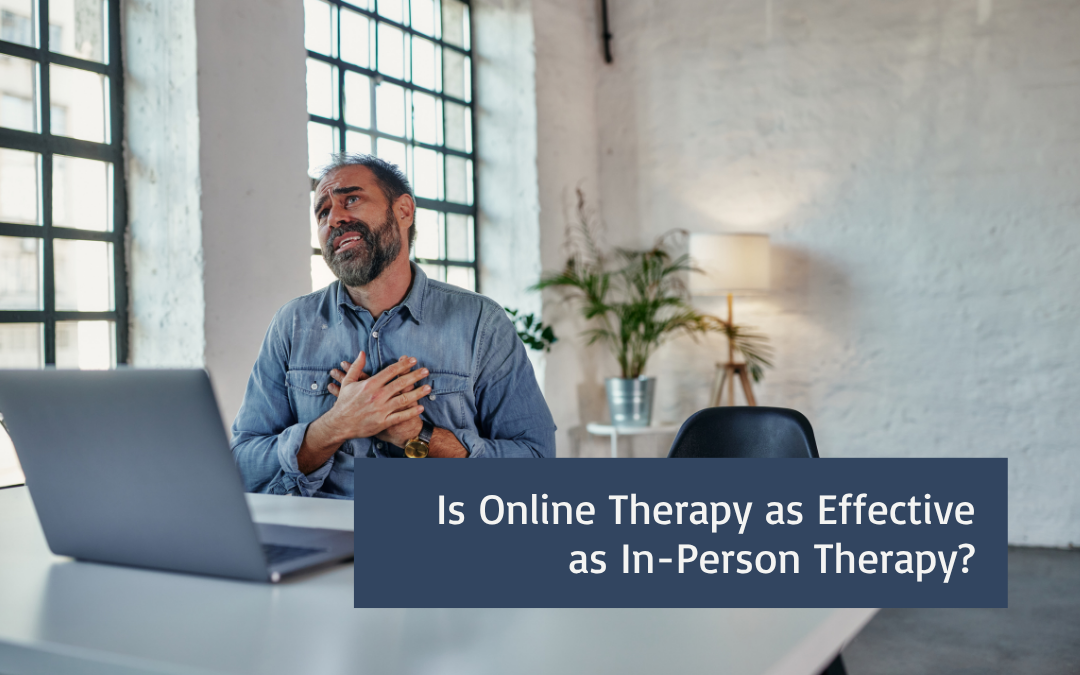
If you’ve been wondering whether therapy over a video call is ‘the real thing’ or a lesser version of what happens in person, you’re not alone. It’s a question we hear regularly at The Therapy Hub. The image most people carry of therapy is a quiet room, a couch maybe, a therapist sitting across from them. Online feels different. You can do it from your bedroom, your kitchen table, the car parked outside work. That informality can feel like a compromise when you haven’t tried it. For most people, once they do try it, the concern dissolves fairly quickly.
What the research actually shows
A large and growing body of research has found that online therapy produces outcomes comparable to in-person therapy across a wide range of presentations, including anxiety, depression, PTSD and relationship difficulties. A 2021 review published in Psychological Medicine found that video-based therapy was as effective as face-to-face therapy for treating depression and anxiety, a finding that has since been replicated across multiple studies and different clinical populations.
The therapeutic relationship, widely understood to be the most powerful factor in therapy working, was an early concern when telehealth became more widespread. The worry was that something essential would be lost through a screen. The research hasn’t borne that out. Clinicians and clients across multiple studies report that meaningful, trust-based therapeutic relationships can be built and maintained just as effectively in an online format.
Telehealth therapy became mainstream during the COVID-19 pandemic, not entirely by choice, but the evidence generated in that period has been instructive. What researchers and clinicians both found was that for the vast majority of presentations and most evidence-based therapeutic approaches, the format made far less difference than the quality of the relationship and the skill of the therapist.
What works particularly well in an online format
For many people, online therapy removes the real barriers that would otherwise prevent consistent support. Access, travel time, fitting sessions around a busy schedule, taking time off work, arranging childcare: for anyone managing competing demands, these aren’t minor inconveniences. They’re the things that cause people to cancel, delay or never start at all. Telehealth makes it possible to actually show up, and to keep showing up consistently.
Anxiety
For people living with anxiety, the significance of being able to access support from home is hard to overstate. One of the most common barriers to getting help for anxiety is the stress of navigating the process of getting there. Leaving the house, getting on public transport, sitting in a waiting room: all of that can feel like a significant undertaking before a session has even started. Telehealth removes that layer entirely. Our post on 9 ways to calm your anxious brain explores some of what’s useful between sessions, but having sessions themselves become more accessible is one of the most meaningful things that can change.
New and expectant parents
Telehealth has been particularly significant for perinatal clients. New parents are among the groups who most need consistent mental health support and are also among the most logistically constrained when it comes to attending in-person appointments. Getting a newborn or infant fed, settled and supervised just to leave the house for 90 minutes is genuinely complicated. Perinatal depression and anxiety are common and highly treatable, and online delivery removes one of the key practical barriers to accessing that treatment.
People in regional and rural Victoria
Distance from a metropolitan area has historically meant significantly reduced access to specialist mental health support. Online therapy means that someone in regional Victoria can access the same clinicians and therapeutic approaches available to clients in inner Melbourne.
Couples therapy
Couples therapy is increasingly delivered online and consistently reports strong outcomes in this format. Having sessions from home removes the logistical challenge of coordinating two schedules to be in the same place at the same time.
Ongoing therapy with an established therapist
For clients who have an established relationship with a therapist and want to continue that work during a period when in-person attendance isn’t practical, telehealth offers continuity that would otherwise be interrupted. Maintaining momentum in therapy matters, and having the option to switch to online for a period without losing the therapeutic relationship is genuinely valuable.
A clinician’s perspective
Callista Goh, therapist at The Therapy Hub, works with clients across both online and in-person formats. Here’s what she notices:
“For clients living with anxiety, one of the biggest barriers to therapy is leaving the house. Telehealth removes that barrier. They get to access support from their own space, with their own creature comforts around them, their favourite chair, their favourite mug. That matters more than people realise.”
Callista Goh, Therapist, The Therapy Hub
Callista is also direct on the question of whether the therapeutic relationship suffers online:
“The bonds I’ve built with clients I see via telehealth are just as strong as those I’ve built in person. Online therapy really does depend on the person, their preferences, their situation and their schedule. For most evidence-based therapies, CBT, Internal Family Systems, ACT, it can be just as effective, if not more so, because the person is already in a space where they feel at ease.”
Callista Goh, Therapist, The Therapy Hub
Privacy and confidentiality online
Sessions at The Therapy Hub are run through a secure, encrypted clinical platform, not a standard video call application. The platform meets Australian healthcare privacy standards.
Your end of the session is your responsibility to manage. The most common practical consideration is having a private space where you won’t be interrupted or overheard. For people living with others, this sometimes takes a bit of planning: a parked car, a room with the door closed, headphones. It’s worth thinking through before your first session.
When in-person therapy might be the better fit
Online therapy isn’t the right fit for every person or every presentation. There are situations where being in the same physical space as a clinician adds something important.
Certain therapeutic approaches work best in person. ERP (Exposure and Response Prevention) for OCD involves incremental exposure work that is harder to replicate online. EMDR therapy is another where some therapists and clients prefer the in-person setting, particularly in the early phases of treatment. Assessments for ADHD and autism are typically conducted face-to-face. If you’re considering an assessment, our neurodiversity-affirming assessment services can advise on format when you make contact.
Some people simply connect more easily in person. That’s not a limitation. It’s just how some people are built, and knowing that about yourself is useful information.
It’s also worth knowing that you can mix formats. Some clients see their therapist in person for the first few sessions to establish the relationship and then shift to a mix of online and in-person depending on the week.
Common questions about online therapy
Can I get a Medicare rebate for online sessions?
Yes. Medicare rebates apply to telehealth sessions with eligible mental health professionals in the same way they apply to in-person sessions. You’ll need a valid Mental Health Treatment Plan from your GP. Our post on understanding Medicare sessions and referrals has a full explanation of how the rebate system works.
What platform do you use?
Sessions are run through a secure, encrypted platform designed for clinical use. You’ll receive a link before your appointment. You won’t need to download software or create an account.
What if the technology doesn’t cooperate?
If a connection drops or quality becomes poor, your therapist will make contact via phone to continue the session or reschedule as needed. It’s worth having your phone nearby at the start of each session as a backup.
Do I need a dedicated space?
No. You need enough privacy to speak openly and enough quiet to focus. That might be a bedroom, a kitchen, a parked car or a quiet corner of wherever you happen to be.
What to expect in your first online session at The Therapy Hub
The structure of a first online session is the same as a first in-person session. Our post on what to expect at your first therapy appointment covers this in more detail.
It doesn’t need to look perfect. You can be at your kitchen table. What matters is that you have enough privacy to speak openly and enough quiet to actually be present in the conversation.
Getting started
The Therapy Hub offers both online and in-person therapy from our Footscray clinic. Whether you’re in Melbourne, regional Victoria or anywhere in Australia, we’re able to support you via telehealth across the full range of our services.
If you’re not sure whether online or in-person is the right fit for you, reach out and we’ll help you work it out. You don’t need to have it sorted before you get in touch.
To book a session or make an enquiry, visit thetherapyhub.com.au, email hello@thetherapyhub.com.au or call (03) 9958 8772.









Recent Comments