A Practical Guide for GPs and Allied Health
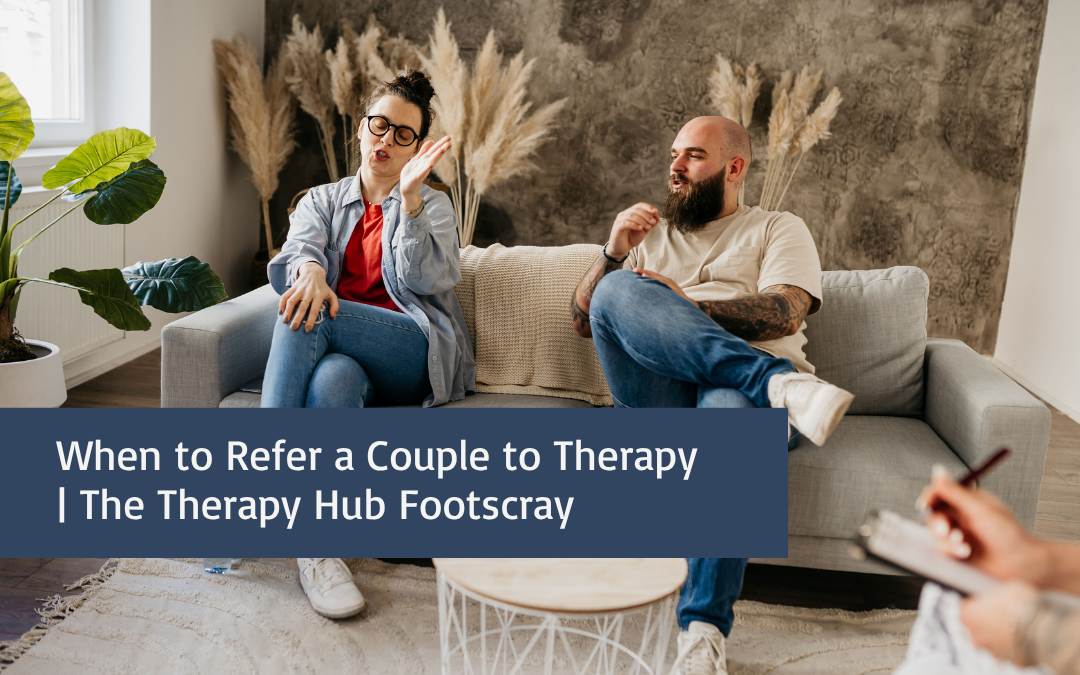
Couples therapy is one of the most underutilised referral pathways in general practice. It tends to be considered a last resort, something to suggest when a relationship is already in serious difficulty. The research tells a different story. Earlier referral consistently produces better outcomes, and the couples who wait the longest are often the ones who need the most intensive support by the time they arrive.
This post is written for GPs, social workers, psychologists and other allied health professionals who want a clearer picture of when couples therapy is appropriate, what to expect from the process, and how to refer to The Therapy Hub in Footscray.
How relationship distress tends to present in a clinical setting
Couples rarely present to a GP and say their relationship is struggling. What they do present with, fairly consistently, is anxiety, low mood, disrupted sleep, fatigue or physical symptoms that don’t have a clear medical explanation. When you ask what’s happening at home, the picture often becomes clearer.
It’s also common for one partner to seek individual support for something that has a significant relational component. Depression following a major life transition, anxiety that seems linked to conflict at home, or difficulty adjusting after a new baby are all presentations where a couples referral alongside or instead of individual therapy may be the more useful pathway.
The quality of our close relationships has a direct impact on mental health. When people feel heard, understood and connected in their relationship, they’re more resourced to manage everything else. When they don’t, it rarely stays contained.
Why couples wait so long
On average, couples wait seven years from the onset of relationship distress before seeking professional support. That’s a long time to be in a state of disconnection, unresolved conflict or quiet withdrawal before anyone intervenes.
There are understandable reasons for this. Couples therapy still carries a stigma that it means the relationship is over or in serious trouble. Many couples operate on a logic of it’s not that bad yet, without ever defining what that threshold actually looks like. Others worry about the time and financial investment, or about opening up difficult conversations in front of a stranger.
A useful analogy is dental pain. When a tooth starts to ache, it’s easy to take a painkiller and wait. The pain often passes, for a while. What might have been a straightforward fix at the first sign of trouble can become something that requires a much more involved and costly process later. Relationship distress works in a similar way. The patterns that are hard to shift after seven years were often much more workable at year two.
Signs a couple may benefit from referral
There’s no single presentation that indicates couples therapy is the right next step. The following are worth holding in mind as referral triggers.
Recurring conflict that doesn’t resolve, particularly where the same argument surfaces across different topics, often signals an underlying pattern rather than a content problem. Gottman’s research describes this as a perpetual problem and it responds well to structured therapeutic support.
Emotional withdrawal or increased distance is one of the more serious signs. When one or both partners have stopped engaging, or when conversations have become surface-level to avoid conflict, the gap between them tends to widen over time rather than close.
Significant life transitions frequently destabilise relationships that were otherwise functioning well. New parenthood, infertility, pregnancy loss, serious illness, job loss and bereavement all place demands on a couple that can exceed what the relationship has the tools to manage without support.
Relationship strain following a mental health diagnosis in one partner is another common presentation. When one person is managing depression, anxiety, ADHD or trauma, the relational impact is often underaddressed in individual therapy.
Infidelity or a significant breach of trust doesn’t automatically mean couples therapy is appropriate, but for couples who want to work toward repair, a structured therapeutic process is the most effective way to do that.
It’s also worth noting that if one partner mentions the other is unwilling to come to therapy, that in itself can be clinically relevant information. Difficulty having the conversation about going to couples therapy is sometimes a sign that the couple could benefit from having supported conversations.
Check out this post When to Refer Clients to Couples Therapy: Key Signs and Strategies for Practitioners
What the Gottman Method involves
The Gottman Method is one of the most extensively researched approaches to couples therapy available, with over 40 years of clinical study behind it. It’s structured, skills based and grounded in three areas: strengthening the friendship between partners, improving the way conflict is managed, and building shared meaning in the relationship.
One of the things that makes Gottman therapy particularly useful for referrers to understand is that it isn’t about deciding who is right. It’s about identifying the patterns that are keeping the couple stuck and building the skills to move differently. Many couples come in expecting to present their case and leave with a verdict. What they find instead is a structured process of understanding each other more accurately.
Underneath almost every conflict there is an unmet need. The Gottman framework helps couples identify what that need actually is and find a way to communicate it that the other person can actually hear. That shift alone can produce significant change.
What to expect from couples therapy at The Therapy Hub
At The Therapy Hub, Marie Vakakis, Tham Fuyana and Ozlem Mehmet-Radji all work with couples and are trained in the Gottman Method.
The early sessions involve a thorough assessment of the couple’s relationship history, strengths and areas of difficulty. Subsequent sessions are goal focused and draw on the specific findings from that assessment.
For couples who want to make meaningful progress in a shorter timeframe, we also offer Gottman Marathon Sessions. These are extended therapy blocks across consecutive days and they’re well suited to couples with limited regular availability or a specific goal they want to work toward intensively.
We currently have no waitlist for daytime couples appointments. Sessions from $200 and Medicare rebates are available with a valid Mental Health Care Plan.
How to refer
You can refer by fax to (03) 9923 6856, by email to hello@thetherapyhub.com.au or by phone on (03) 9958 8772. Clients can also self-refer directly through our website.
If you’d like to discuss whether couples therapy is appropriate for a particular patient before referring, we’re happy to take that call.
For more on how couples therapy works and what it involves, you can also share our blog post with patients:
- How Couples Get Stuck in Conflict and When Couples Therapy Can Help
- Does Couples Therapy Mean Our Relationship Is Failing?









Recent Comments